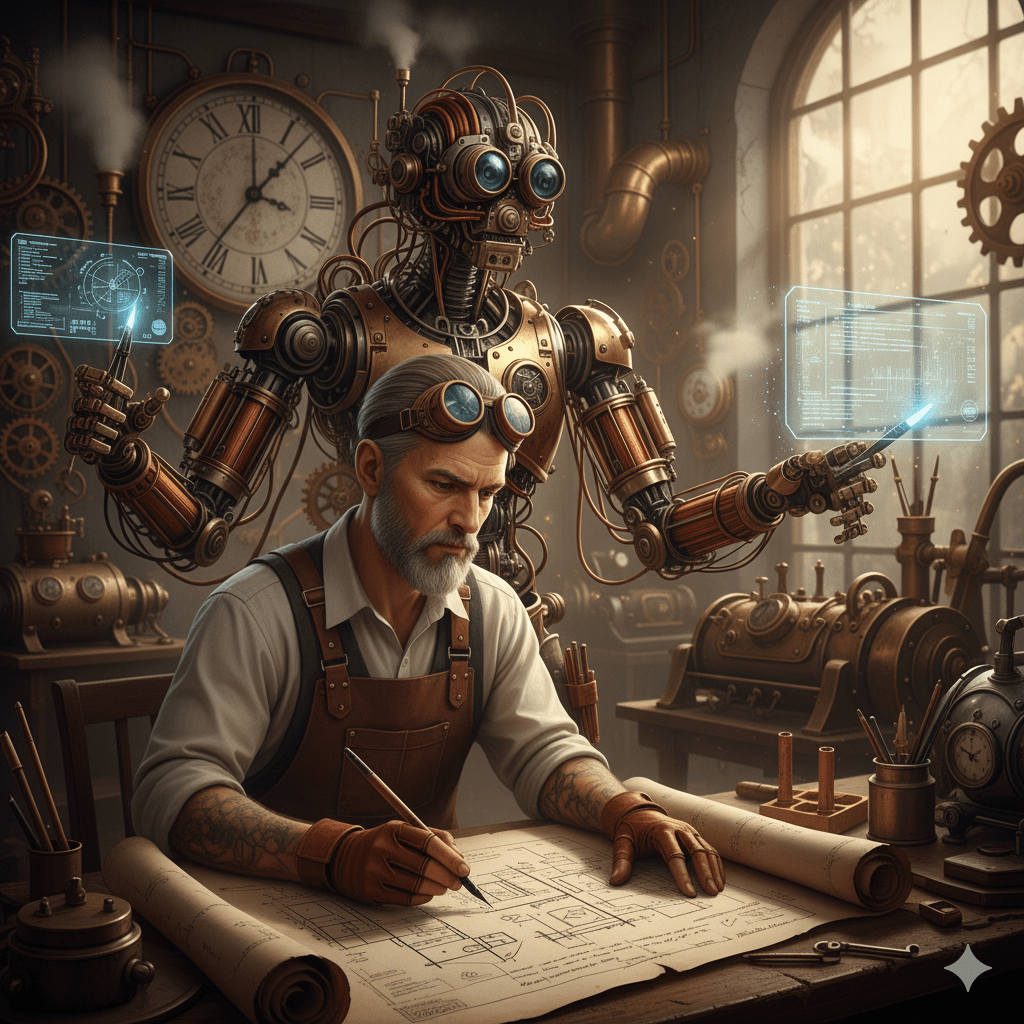
The past period has been the true launch of my journey into AI.
I usually rely on my intuition, experience, and integrity. Now, I’m experimenting with an artificial partner to support my thinking and design. The big question is: Will this ‘partner’ truly support me? I’m eager to find out.
This my second post on this topic, for the first post check out this link.
Ownership
I see a clear quest for ownership and a shift in traditional roles. This is fundamentally a mindset change that will take time to overcome..
For example, it sounds great that designers can quickly mock up designs, which includes production code, so the developer can seamlessly continue. But can the developer also not start mocking up design?. Can the product manager also not create a product prototype at the start of a project?
On one hand, this overlap is a great thing—we blend unique skills while moving into adjacent areas. On the other, however, it risks pushing us apart, making us more ‘mono’ rather than ‘stereo’ and actually limiting collaboration. My firm belief is: “The beauty lies in the middle”!
I’m the first to admit my own mindset is biased. In this article it is stated that: “Many people think that the new tools will mean that anyone could cover any of these roles.” and “Realize that we have had no-code and low-code user programming tools for several years. And we have also known that design tools can be learned and used by product managers and engineers alike. Yet the results are rarely what anyone was hoping for. As always, it’s not the tool; it’s what you choose to do with that tool.” I believe (and hope) that the industry will tremble for a period, but ultimately, professional lines will largely fall back to our core skills, now simply enhanced by AI augmentation.
From the same article, I do appreciate this quote “Further, I argue that the critical competencies needed will continue to be distinct enough, and deep enough, that in most cases, product teams will need a product manager to solve for the many business constraints, a product designer to solve for the user experience, and an engineer to solve for the technology.” I like the smaller team setup as it many stakeholder discussions and engagements.
Think outside the tool
It is a healthy mindset when designers can think outside the tool, like thinking outside the box. It is damn-easy to follow the ready-made proposals that AI tools can offer you. Still, you always stay inside that tool..
As a designer you will need to understand when to take a step back and act in the real world (of your users). Discard your ideas, instead of making more. Yes, you will be capable of creating your ideas into reality faster. But will you use that ‘gained’ time to step-out and make REAL sense of the ideas, rather than be awed by the swiftness of creating one idea, and the ability to make more?
I look critically at the current phase. I certainly need to ‘fall in love’ first, like many people I see around me. But, I honestly think I rather have a normal relationship with a tool 🙂
Lost skills
Beyond the hype of ‘up-skilling’, we must also understand the opposite that will happen: the inevitable ‘lost-skill’ that will occur..
If things become so easy with augmented tooling, you are forgetting how to do it without that tool. How many people can still draw with pen and paper before using a digital tool? How many people can still count in their heads? In that sense, I wonder about the true meaning of the word Artificial Intelligence. Will it make us humans smarter as well, or will it make us more dumb?
This article triggered my thinking, where a designer starts with a pen and paper before using AI to make that into a functional software application. While I believe that latter part is certainly possible, I certainly have my doubts if people still know how to hold a pen and paper and draw something that is a good basis for a design..
Normally, when I design from scratch, I have thought about every interaction and every pixel, redesigning and improving it continuously. If we get bombarded by AI solutions created fast and sometimes without enough human involvement, will we still be capable of judging if something is good? At this moment, we often see an AI solution quite quickly and clearly as ‘not great’, but this will evolve as the technology evolves. It is too early to really know, and I am looking with a critical yet curious eye at these developments.
As Marty Cagan puts it in this article: “We need to understand the problem we’ve been asked to solve, and figure out a good solution (product discovery), and then we need to build, test and deploy that solution to our customers (product delivery). Everything in product has some amount of judgment, and some amount of process, but product discovery is primarily about judgment, and product delivery is much more about process. Most of the newly emerging tools focus on product delivery”
Even though also tools emerge for product discovery, it does not mean that everyone can make a successful product into reality based on an idea, pretty much like Steve Jobs said in this video.
I maintain my excited skepticism, but I believe we can absolutely ride this wave—provided we drop the fights for ownership, remain brutally critical of the tools themselves, and never stop mastering our essential human skills.
Stay tuned for more updates!
Resources
- MA Vision For Product Teams (article) https://www.svpg.com/a-vision-for-product-teams/
- So Long, Figma. Thanks for Everything (article) https://jondaiello.medium.com/so-long-figma-thanks-for-everything-f606e5f75b7c
- Steve Jobs explains the difference between a great idea and a great product (Youtube video) https://www.youtube.com/watch?v=sm1msysj5lw

Leave a comment